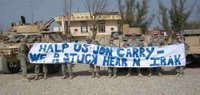
This is copied from the MinnPost.com
"Now that Congressman Tim Walz in southern Minnesota seems to have buckled to the pressure to have a town hall meeting on health care reform, folks in the northern part of the state might be wondering if Congressman Jim Oberstar might have similar plans.
Nope, says the Duluth News Tribune.
The paper reports:
"[Oberstar] typically does not do townhalls per say [sic]," [said spokesman John Schadl.]
Oberstar prefers forums with specific focus groups or interested parties, such as a forum he did last week in Pine City with farmers on dairy issues, Schadl said. "These town hall meetings have become so politicized, and he finds it so valuable to reach out to people when he travels, talk to them directly."
Schadl said that Oberstar has had numerous meetings with constituency groups on health care reform in the past year.
Of course, Oberstar is a 17-term DFLer in a DFL district, while Walz is a second-term DFLer in a traditionally Republican district. "
There is a letter from the editor in the Post Review, I have written this man, called his office, gone to his facebook page....How do you stay a 17 term Senator without talking to your constituents? Oh, I forgot, dfl district..no questions asked for many, many years...time to wake the sleeping elephant people!
Showing posts with label Oberstar. Show all posts
Showing posts with label Oberstar. Show all posts
Friday, August 14, 2009

Tuesday, February 12, 2008
Bridge Analysis
MoDOT Completes Preliminary Study of Minneapolis-Type Bridges
156 Deemed Safe So Far, Remaining 76 Will Get Further Study
156 Deemed Safe So Far, Remaining 76 Will Get Further Study
Preliminary studies of all Missouri bridges with gusset plates similar to the collapsed bridge in Minnesota are complete, with many already confirmed as safe, Missouri Department of Transportation bridge engineers announced.
Engineers are evaluating the state's 232 truss bridges.
Read more....
Missouri took the NTSB’s press release seriously as all jurisdictions were urged to do. Meanwhile, Oberstar tried to make political hay out of Rosenker’s preliminary findings. MoDOT Director Pete Rahn knows, in a real world, he must not ignore NTSB (to his own peril if a bridge collapses), but Oberstar has the luxury of politicizing the real world report.
Even Louisiana is following suit.
William D. Ankner, Louisiana Department of Transportation and Development Secretary designee, said the recent federal report citing the steel plates connecting the beams of a bridge’s frame as the probable cause of the Minneapolis bridge collapse caused Louisiana to check its own bridges more closely.
"After the Aug. 1 Minneapolis bridge collapse, DOTD bridge inspectors reviewed and analyzed the inspections of all truss bridges in Louisiana," Ankner said. "However, in light of the federal government’s findings I have directed DOTD engineers to begin an immediate review of the plate design of all similar bridges in the state.
___________________________________________
Isn't it amazing how engineers can read the NTSB report and take prudent action while a politician attacks the reporting NTSB chairman to try and score political points? Motives make all the difference in the world. Engineers try to preserve life and save themselves enormous embarrassment and culpability. Democrat politicians embarrass themselves trying to destroy Republicans who clearly are not at fault while not sensing any guilt whatsoever.
Somewhere in Missouri and Louisiana there certainly must be some Democrats among the engineers who knew they needed to take prudent action. Three cheers for Democrat engineers!
Wednesday, January 30, 2008
Duplicity
Isn’t it amazing how Oberstar and other Dems can denigrate a person’s ability and integrity if they are a Bush or Pawlenty appointee? Rosenker’s integrity is attacked because he is a Bush appointee. Molnau’s integrity is attacked because she is a Pawlenty appointee.
Oberstar is the senior Democrat on the Transportation and Infrastructure Committee and has oversight of the NTSB and its chairman, Rosenker. And yet Oberstar pawns himself off as a public servant when he takes Rosenker to task for his report, which obviously hinders the Dems cause. Oberstar wants us to think his motives are honorable while Rosenker’s and Molnau’s are political. Oberstar thinks he has a right to meddle in the process to get a report he wants. That right is reserved for Dems alone.
Nothing New
Rep. James Oberstar felt compelled to attack NTSB Chairman Mark Rosenker to keep up the Democratic attack on the GOP for the bridge collapse. In a courtesy of hand-holding the Representative, Rosenker met with Oberstar to explain a few things that he seemingly could not understand by hearing and reading the NTSB report.
No new information comes from this meeting. The gussets were still undersized and the undersized gussets were not compromised by corrosion. See our previous post. According to MPR, "Rosenker said he meant only that the under-designed gusset plates didn't show signs of corrosion." We knew that from the NTSB report. See also the Strib report on the meeting.
Oberstar’s letter to Rosenker is in contrast to his official web site which has a press release that shows he had an accurate understanding of the NTSB report as of January 15 and a measured response to it. Oberstar knew all along there was nothing to be clarified by Rosenker. On his web site, he even praised the benefit of the NTSB’s report on the undersized gussets so all governmental agencies can review their bridges.
This duplicity is disgusting for it is pure pandering to show Big Daddy is looking out for us. Don’t expect an apology from Oberstar for trying to make something out of nothing. With the web available to all of us, it is easy to find this hypocrisy. Thank you Al Gore for inventing the Internet!
___________________________________________
Update
Read the New York Times article on the topic.
Thursday, January 24, 2008
Oberstar Pouts
Rep. Oberstar criticizes NTSB chairman's 35W bridge findings
The Minnesota Democrat said corrosion and cracking should not have been dismissed as possible fatal flaws.
By KEVIN DIAZ, Star Tribune
Minnesota Democrat Jim Oberstar, chairman of the House Transportation Committee, fired off a critical letter to the head of the National Transportation Safety Board (NTSB) on Wednesday, saying it was "highly inappropriate" for him to dismiss corrosion and poor maintenance as possible causes for the Interstate 35W bridge collapse.
Read more...
The Minnesota Democrat said corrosion and cracking should not have been dismissed as possible fatal flaws.
By KEVIN DIAZ, Star Tribune
Minnesota Democrat Jim Oberstar, chairman of the House Transportation Committee, fired off a critical letter to the head of the National Transportation Safety Board (NTSB) on Wednesday, saying it was "highly inappropriate" for him to dismiss corrosion and poor maintenance as possible causes for the Interstate 35W bridge collapse.
Read more...
___________________________________________
Oberstar can’t quit stirring the pot because, in the words of the reporter,
"A design flaw would give Oberstar and other DFLers less of an opening to hold officials at the Minnesota Department of Transportation and Gov. Tim Pawlenty responsible for what they view as a lack of inspection and proper maintenance on the bridge."
Rosenker has been attacked for being a Bush appointee. Now it is Rosenker’s inexperience at NTSB that Oberstar attacks. Any excuse will do for him to avoid facing reality when he is determined to pin the cause on the GOP. Rosenker, speaking for the NTSB, identified a design flaw that resulted in the bridge collapse and stated corrosion or lack of maintenance did not bring the bridge down. Undoubtedly, the NTSB examined all the beams and gussets and noted the condition of each.
If we were allowed to examine each gusset, I would suggest that the average non-engineer could identify which gussets broke and if corrosion were involved.
- We could identify gussets that bent as a result of a bridge section collapsing.
- We could identify gussets that cracked sometime ago because the metal surrounding the crack would be rusty.
- We could identify gussets that cracked very recently because the metal surrounding the crack would be bright and shiny.
- We could identify gussets that flaked and crumbled due to corrosion.
- We could identify gussets that cracked from the top or from the bottom.
- If we looked at a bent gusset with some corrosion on it, we could tell if it was bent due to the leverage of a collapsing section or the result of corrosion.
- We could identify gussets that were sheared and ripped.
- We could identify gussets that were of different thicknesses.
- And if we identified gussets that were thinner than others and sheared, we would conclude the gussets were undersized compared to the rest.
A person does not need to be an engineer to identify these features about gussets. In the real world, a group of non-engineers selected randomly from society who were given opportunity to look at the gussets would be able to draw some highly accurate conclusions. That group may not be able to identify the first gussets to break, would not be able to do the mathematical calculations, would not be aware of all the forces at work on the bridge structure, may not be able to identify what caused the undersized gussets to break now and not previously and it could not identify the actual problems before the bridge collapsed. However, that group would be able to identify the sheared gussets and whether corrosion was the cause of the shearing of those gussets.
Oberstar deliberately underestimates the capability of the NTSB even though our group could come up with a report with a high degree of accuracy. In fact, if Mr. Oberstar (randomly selected and unprejudiced) were in that group, he would be able to identify which gussets broke and if corrosion were involved.
But since Oberstar wants to play politics with safety, he will instinctively reject the obvious. And instinctively, Oberstar projects on to the NTSB his very own politicizing of the bridge–Rosenker is a Bush appointee and inexperienced. Is everyone at NTSB a Bush appointee and inexperienced? Oberstar must have corrosion as the cause for failure because undersized gussets don’t cash in politically as corrosion may.
Oberstar does not ever have to be right, so he can keep carping. The NTSB must be right the first time they make a report because safety and credibility are riding on their work. Oberstar doesn't have to live in the real world; the NTSB does.
Wednesday, October 03, 2007
Part of the Problem, not the Solution
The former state transportation commissioner said the I-35W bridge collapse changed his mind about the race and inspired him to run again for his party's nod.
By Bob Von Sternberg
By Bob Von Sternberg
Saying Sixth District U.S. Rep. Michele Bachmann has "built her career around divisive issues and a partisan approach," former state Transportation Commissioner Elwyn Tinklenberg launched his second bid for the seat on Monday.
He said his decision was wholly prompted by the collapse of the Interstate 35W bridge on Aug. 1: "I knew at that moment I couldn't sit by and allow this inattentiveness to continue."
___________________________________________
So Tinklenberg knows he must run for office because the I-35W bridge collapsed. Rep. Bachmann isn’t attentive, but he will be.
Say Mr. Tinklenberg, what were you doing back when Jesse Ventura was governor? Weren’t you Transportation Commissioner? What did you do back then to ensure the maintenance of that bridge? Oh, I remember. You were part of the group pushing light rail and diverting huge dollars to it. You are part of the problem the state is in.
Tinklenberg is just like Congressman Jim Oberstar, a long time transportation chair, who has known about the need for bridge repair for decades and done little or nothing to provide money for that mundane work, but lavishes dollars on pork barrel projects.
These Dems have no shame, no embarrassment, no recollection of history. While promising to solve the bridge problems, these men have not been part of the solution.
It’s time for Minnesotans to reject those who have been the problem.
Tuesday, September 18, 2007
More "Transportation" Pork
Funding for bridges served with side of pork
Senate set aside $1 billion for worn spans -- and $2.5 billion for "earmarks."
By Kevin Diaz
Bridges are aging and rusting all over the country, but if Congress has its way, Las Vegas will get a history museum out of the Senate-approved transportation and housing bill soon headed to President Bush.
North Dakota will get $450,000 for its Peace Garden on the Canadian border, while Montana will see funding for a minor-league baseball stadium in Billings. So too will Minnesota get $250,000 in the House version -- for bike trails.
The U.S. Senate bill does contain an extra $1 billion for bridge repair. But the amount set aside for pet transportation and community projects would be more than double that: In all, 843 new congressional "earmarks" totaling $2.5 billion.
Read the rest of the article.
___________________________________________
While federal pork continues to outpace maintenance dollars for bridge repairs, the Governor of Minnesota kept the Dems from filling the special session with pork. The Dems can’t wait for the next half year to fly by before the regular session commences so they can legislate more taxes.
Click here for information on the financial aid package passed in special session for flood relief. Some state money was appropriated to get federal funds for the I-35 bridge.
See this information for a listing of private donations for flood relief, Minnesotans helping Minnesotans. And wonder of wonders, it is voluntary!
Monday, September 17, 2007
Porker of the Month
For the month of August, Citizens Against Government Waste gave its Porker of the Month Award to US Rep. Jim Oberstar (D-MN). See our previous comments about him here and here.
Saturday, August 25, 2007
Interview with Rep. James Oberstar
Source: Star Tribune
'Bridge maintenance is in the Stone Age'
Rep. Jim Oberstar, D-Minn., chairman of the House Committee on Transportation and Infrastructure, sat down last week with Star Tribune editorial writers to discuss the Interstate 35W bridge collapse. Here are excerpts:
Published: August 26, 2007
Q What should be the federal response? You've mentioned a gasoline tax increase. President Bush says he's against that.
A Let me cite testimony from Dec. 1, 1987, from two days of hearings I conducted on bridge safety. "Our national bridge program is in serious trouble. The safety of millions of Americans have been jeopardized by inept federal stewardship over our bridge inspection and rebuilding effort. States have misspent millions of federal aid bridge dollars through dereliction of their responsibilities to the traveling public. One of the most fundamental defects is the persistent failure of states to perform reliable, cost-effective maintenance of our bridges in compliance with federal statutory responsibilities. Bridge maintenance is in the Stone Age."
That was 20 years ago ... and very little has been done [by various administrations, Congress or the states]. It has only gotten worse. So this disaster is not really a wake-up call, it's a reawakening.
In the 1960s, when the Minneapolis bridge was built, we had 2 million trucks on the road in America. Today we have 7 million. And now we have just-in-time delivery of freight, which requires our highways to be rolling warehouses. Instead of 53,000-pound trucks, we have 80,000-pound trucks. We have 235 million vehicles in the U.S. That's huge pressure, far different than where we were when most of our bridges were built.
Q You have an initiative in mind.
A Yes. We have 597,000 bridges in America, of which 154,000 are deficient, either structurally or functionally. This is an opportunity. Instead of making Minnesota as a poster child for bridge failure, we should make this tragedy a springboard for action and attack in a focused way those most-vulnerable bridges. We should raise the standards on deficiency, raise the standards for inspections and the federal oversight of state responsibilities, develop a formula for rating deficient bridges based on threat to public safety, risk, importance to mobility. We need new ratings, state by state, a ranking of those most critical to be repaired. [Ratings would be done by the Federal Highway Administration and the states, and validated by the National Research Council.]
I also want to include in the formula a state's commitment to providing its matching share to the federal dollars. And then the cost. Create a Bridge Reconstruction Trust Fund, separate from the Highway Trust Fund, to create a dedicated revenue stream to respond to those needs.
I propose a 5-cent increase of the user fee [gas tax] for three years, generating about $8.5 billion a year, although the actual amount will depend on what the cost estimates are once the bridges are evaluated. Then I have an earmark-proof provision, drawn to be an emergency response. It's critical for people to believe that there won't be any tampering. It's a three-year crash program with a three-year sunset.
Q What do you make of the president saying no?
A Well, it was an offhand response. He also said that Congress has to fix the highway program, so I take him as a yes.
Q Can the construction industry handle all that in such a short window?
A Yes, I've talked to them.
Q Can the economy handle a nickel increase?
A These projects would increase the efficiency and reliability of moving goods and people, and they would create thousands of construction jobs.
Q And, in your formula, states that don't show commitment to matching federal dollars would suffer?
A I expect they would; this is a partnership.
Q In Minnesota, the governor has twice vetoed legislation that would have raised more federal matching money for transportation. Do you consider Minnesota a good partner?
A Our lieutenant governor [Transportation Commissioner Carol Molnau] told me in October 2005, "We can't match all that money you want to give us." I said, "Then raise the user fee [gas tax]." As a policymaker, you cannot be stuck in an ideological time block. If it were left up to these people, we'd still be riding ox carts in Minnesota.
Q What should be Minnesota's response to this bridge collapse?
A Well, two. The first is what the state is doing now. Get a proper design and make sure it has funding to pay the up-front costs that will be reimbursed later by the federal government. That's the standard procedure. But what we understand is that the state has a cash-flow problem, and may have trouble. I don't want to see them shift money from other projects to this one.
Then, the state has a larger problem. For 20 years the user fee [gas tax] has not been increased, while the value of the construction dollar has eroded 47 percent. Our GDP was $89 billion back then; now it's $256 billion. Usage of the roads has increased tremendously; truck weights have increased, resulting in huge pressures. The user fee [gas tax] is not sufficient to keep up to these needs. They have to deal with this problem, and they can't do it with a sunsetted user fee.
___________________________________________
Oberstar is given to hyperbole. He quotes testimony approvingly from 1987, which said, "Bridge maintenance is in the Stone Age." Oberstar himself criticizes Minnesota policymakers, saying, "If it were left up to these people, we'd still be riding ox carts in Minnesota." Neither statement is true nor helpful. Our modern road system could not have been built by ox cart technology nor stone tools. In reality, this statement would more accurately be true of radical environmentalists who detest use of the internal combustion engine.
Oberstar has a solution for aging interstate bridges–a new program and new tax dollars. What else is new? He wants to create a Bridge Reconstruction Trust Fund separate from the Highway Trust Fund which was created in 1956 to fund highways and bridges. Why is a separate fund needed? Politicians will misuse a new fund just as they have misused the Highway Trust Fund (see this opinion for example).
A three-year, temporary 5 cent per gallon gas tax would be the funding mechanism. When does government keep anything temporary Mr. Oberstar? And the new program would be "earmark proof". Oh really! The last transportation bill was overloaded with earmarks. Why not make the existing Highway Trust Fund earmark proof? Why do it just for bridges?
And isn’t Mr. Oberstar part of the problem that he says has been with us for more than 20 years? Being chair of the Transportation Committee for many years, he should have been pushing for corrective measures because he was forewarned in 1987. And now the exclamation point occurred in his own state! Twenty years is more than enough time to bring correction.
Leave it to the audacity of politicians. Your tight grasp on your wallet is the problem; not their mismanagement. And don’t wait for any apology from pols even though they are the problem. In the end, the hard working American taxpayers will once again bail out mismanaging politicians and bureaucrats.
We don’t need a new program and new money. We need new people in political office and in bureaucratic office, such as the Highway Trust Fund. There will be plenty of money to go around once the waste and pork is eliminated.
Friday, August 24, 2007
Well Said, Therefore Everyone Listen
Until I-35W disaster, Oberstar's funding focus wasn't on bridges
By Katherine Kersten, Star Tribune
In the wake of the Interstate 35W bridge collapse, DFL leaders want to raise the state gas tax to fund transportation needs.
At the same time, Minnesota Rep. Jim Oberstar -- the powerful chairman of the House Transportation and Infrastructure Committee -- has called for a "temporary" 5-cent increase in the federal gas tax to raise what he says is a critically needed $25 billion over three years for a national bridge-repair trust fund.
"If you're not prepared to invest another five cents in bridge reconstruction and road reconstruction, then God help you," he said after the bridge collapse.
Polls suggest that ordinary folks aren't convinced of a divine mandate for higher taxes. Most likely, they're skeptical about how our pols are stewarding current transportation funds.
Oberstar is Exhibit A. He's long been well-positioned to help steer funds toward bridge safety, and has known of the seriousness of the problem since he held hearings on bridge conditions 20 years ago, he says. But he's had other priorities.
For example, on July 25 -- a week before the bridge collapse -- Oberstar issued a press release announcing his latest coup for Minnesota.
He had obtained more than $12 million for his home state in a recently passed House transportation and housing bill. Commuter rail was the big winner, getting $10 million. The Cambridge-Isanti Bike/Walk Trail got $250,000, and the KidsPeace Mesabi Academy in Buhl got $150,000. Only $2 million went for meat-and-potatoes road improvements.
Not a penny was slated for bridge repair.
Transportation funding is the epitome of pork-barrel politics. It's notorious for earmarks -- items that politicians insert into bills to finance pet projects in their districts.
Critics call it a spoils system that distributes money based on political clout rather than transportation need.
The 2005 federal transportation bill illustrates the extent of the problem. The $286 billion bill included a record 6,373 earmarks, up from a handful in 1982.
Oberstar played a lead role in crafting the 2005 bill as ranking Democrat on the House Transportation Committee. In the bill, Congress allocated about $4 billion a year for bridge reconstruction and maintenance. It designated about the same amount -- about $24 billion over a five-year period -- for member earmarks in a bipartisan porkfest.
Ironically, $24 billion is almost exactly the amount that Oberstar now says we must raise through new taxes to prevent future bridge collapses.
Oberstar's earmarks were among the highest for any member, totaling $250 million. What did they fund?
Not repair of the I-35W bridge, though the state had identified cracks in the bridge as a major concern in 1999. Oberstar's earmarks, which included many road-related projects, also provided $25 million for Twin Cities bicycle and pedestrian trails and lanes, and such "high priority" items as $471,000 for the Edge of Wilderness Discovery Center in Marcell.
A bridge - but not for vehicles
Oh, and he did slip in $1.5 million for a new bridge in Baxter -- for the Paul Bunyan bike trail.
Oberstar, an avid cyclist, has lavished federal gas-tax dollars on bike trails for years. In 1991, he spearheaded legislation that first allowed Highway Trust Fund monies to flow to state bike trails.
Now Oberstar has taken his enthusiasm for bikes a step further. He recently amended a federal aviation law to allow airports to spend federal funds on bike storage facilities. (Now there's a pressing need we don't want to underfund.)
Could Oberstar be changing his earmark-happy ways? The bridge repair trust fund that he proposed after the I-35W collapse will prohibit earmarks. "I'm challenging everyone to break with the paradigm of the past -- to meet a higher standard," he said.
Does that mean that earmarks have been bad policy all along? Not at all, says Oberstar. "Citizens have a right to petition for redress of grievances. What are we, chopped liver in greater Minnesota? When the state bureaucracy won't fund projects that people need, they come to me for help."
Do we need new taxes to keep our bridges and roads safe? Minnesota reaped a bountiful $3.5 billion from the 2005 federal transportation bill, up almost $1 billion from its allocation under the previous highway bill. The Star Tribune called it a "cornucopia of big-bucks transportation" benefits.
At the state level, Minnesota spends almost twice as much today as it did just 10 years ago.
More taxes? How about doing a better job with what we've got?
___________________________________________
Enough said. No new taxes. Get the priorities right.
Rep. Jeremy Kalin (DFL-17B) and Sen. Rick Olseen (DFL-17) are you listening?
Also read this wise commentary by David Strom.
Subscribe to:
Posts (Atom)